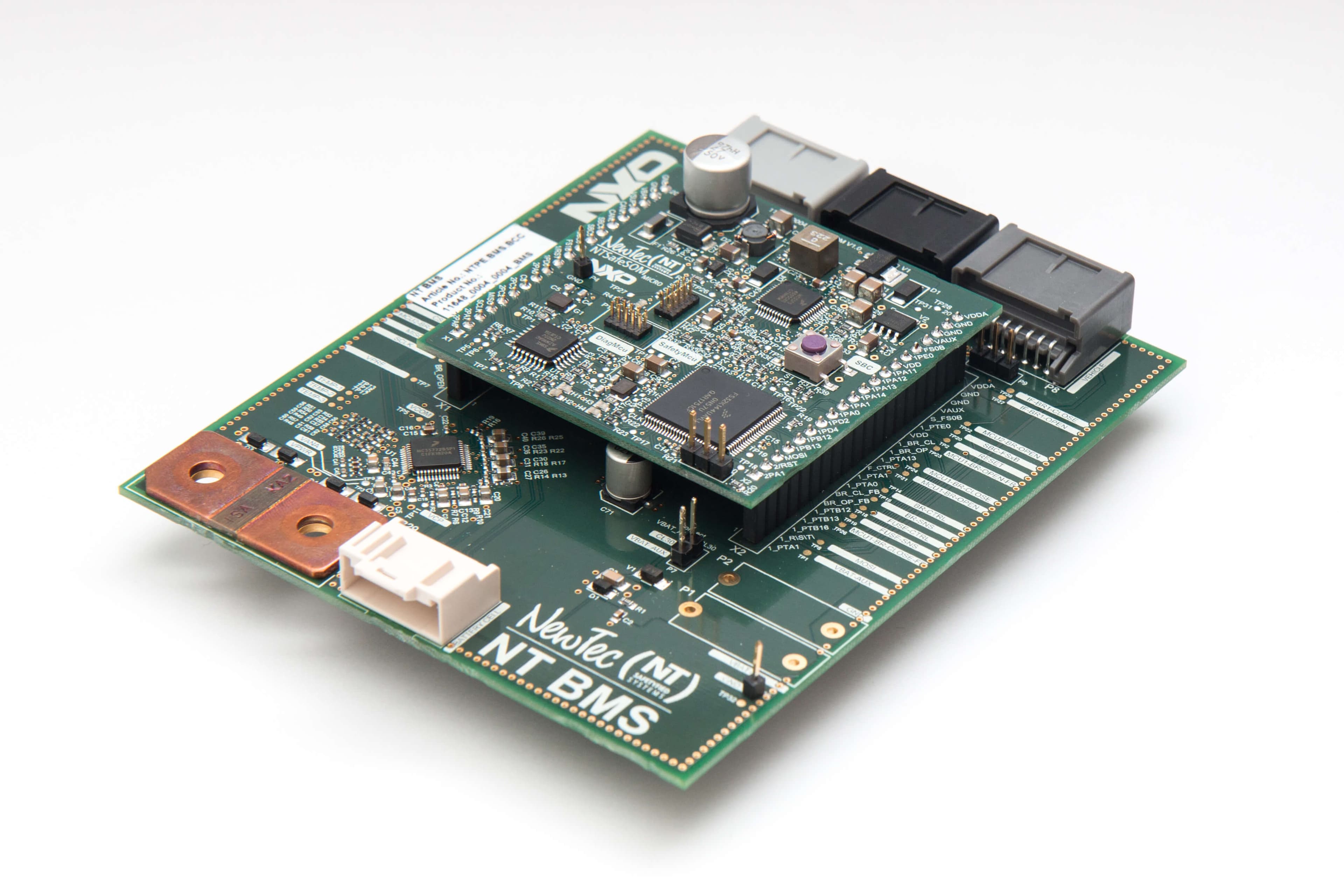
SOMs (systems-on-module) are a proven answer to the increased demands placed on embedded systems. These small, highly integrated subsystems each specialise in controlling one function and have everything required for this on a single board – e.g. processor, volatile and non-volatile memory and a wide range of interfaces. The most important advantages of SOMs: they reduce development times and costs. At the same time, the risk of design errors is reduced. But SOMs can do more than control – they can also do safety.
NewTec's NTBatteryManagementSystem (NTBMS), for example, monitors the charging process, state of charge and temperature of batteries as well as the power supply. On the one hand, this ensures that the battery functions optimally at all times and retains its capacity for as long as possible. On the other hand, it also prevents battery fires and, thanks to crash detection, electrically disconnects the batteries from the vehicle electrical system in the event of an accident.
What applies to highly integrated subsystems in general also applies to safety SOMs: they save development time and development costs. Both the effort involved in specifying the safety requirements and implementing the safety functionalities and the effort in the test and validation phase can be reduced by up to a third.
Small and flexible: NTSafeSOM
NTBMS is based on NTSafeSOM, a generic microcontroller module for safe software development in automotive engineering. As this SOM can easily be integrated into circuits and controllers, it can be used not only for battery management but also for other safety-critical automotive applications up to ASIL C. For example, controllers for sunroofs or ABS valves can be monitored using NTSafeSOM. It can also be used for seat occupancy monitoring systems or for driver assistance systems of levels 1–3. LIN and CAN interfaces are available for communication with other control units.
Although developed for the automotive sector, NTSafeSOM and NTBMS are by no means limited to use in cars. Thanks to their small installation size, they are equally suitable for other mobile applications, for example to prevent e-bike batteries or the interchangeable batteries of power tools from catching fire.
The functionalities of NTSafeSOM also show their strengths in stationary energy storage systems – for example when it comes to monitoring the voltages, currents and fast-charging functions of battery storage systems used to buffer solar installations. Reliable overheating protection is particularly easy to implement – which is especially important in hot summers.
Safety for industry and more: SafeFlexBoard and STM32G070
If safety SOMs are to be used in stationary environments, the basic standard IEC 61508 or sector standards derived from it, such as IEC 62061 for machine control systems, apply with regard to functional safety. Depending on the application scenario, NTSafeSOM modules can be used and certified up to safety level SIL 2, which roughly corresponds to ASIL C. For special applications in industrial environments, however, modules with a consistently dual-channel architecture are recommended. Here, NewTec offers two ready-made modules for different safety levels, which can also be adapted to integrate all required interfaces, including wireless systems if necessary.
Firstly, NewTec has developed a new safety reference design specifically for industrial applications, for components using the popular STM32G0 microcontrollers from STMicroelectronics, which can be certified up to SIL 3. The SafeFlex board with its two FPGAs can also be certified up to SIL 3 and can additionally be connected to a PLC via EtherCAT, PROFINET, PROFIsafe or Powerlink. This allows drives and sensors to be controlled using the safety protocols FSoE, PROFIsafe or openSAFETY, and they can also be upgraded to OPC UA over TSN.
Both modules are particularly recommended for implementing high safety requirements. In robotics, for example, when it comes to monitoring fast machine movements in order to rule out, as far as possible, any hazards to people in their vicinity. Likewise in medical technology, for example for controlling injection robots that use camera monitoring to detect a vein and then administer an injection.