
Your partner for Safe AI.
AI in control systems boosts availability and performance, but it places special demands on functional safety (FuSa): unlike conventional systems, AI can often only be verified statistically, with the variance that comes with it.
NewTec guides you through system, fault and risk analysis, determines the accuracy and performance you need, and clarifies the regulatory requirements (think EU AI Act).
What you gain.
Safe integration of AI technologies, assessed by NewTec’s safety and AI expertise.
Lower risk thanks to development that is EU AI Act compliant from day one.
Lower risk thanks to an approach geared towards TÜV approval.
Innovation and technology impulses from NewTec strengthen your position in the market.
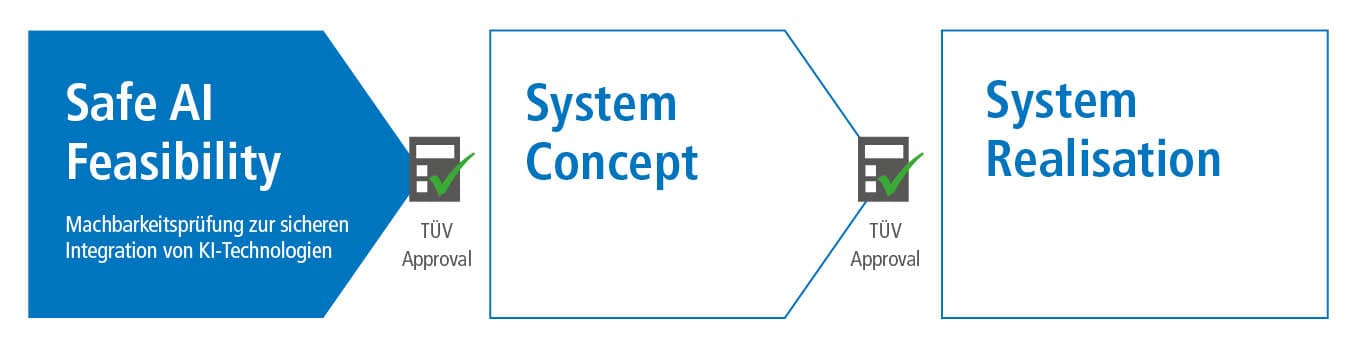
Integrating AI into a safety-related system: what does it mean for development?
The variance of AI technology has to be accounted for during development and reconciled with the risk of harm caused by functional shortcomings. We work out for you whether the planned hardware is reliable enough to run AI technology, and we support you on the path to approval, including by identifying the relevant normative and regulatory requirements.
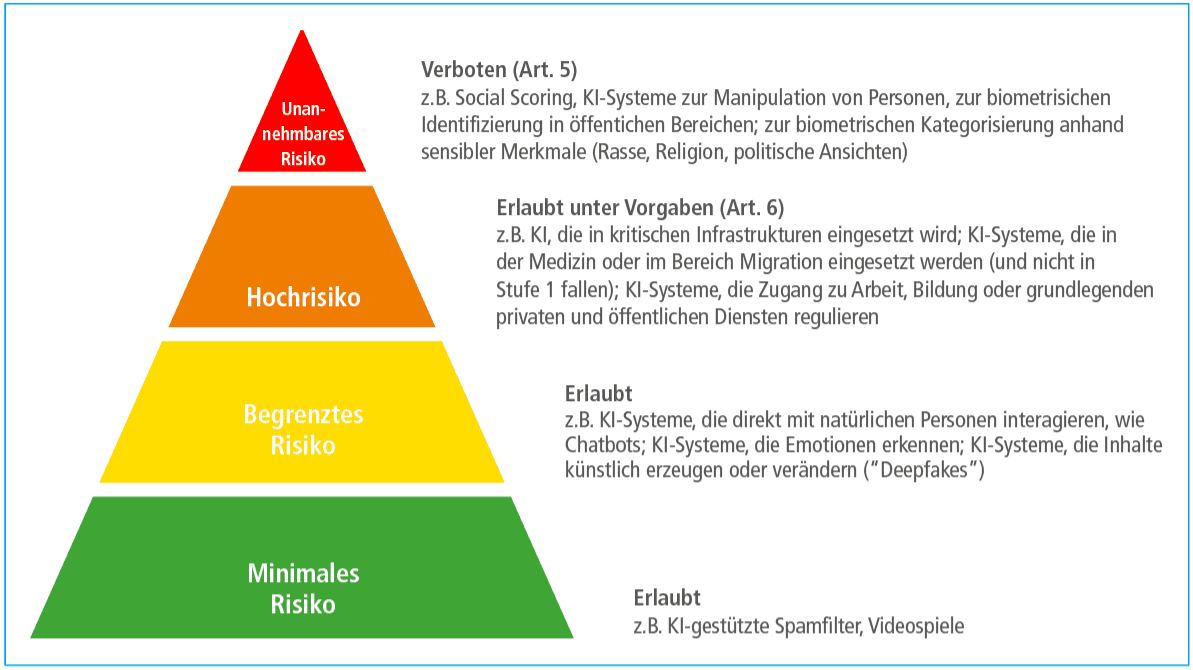
The EU Regulation on Artificial Intelligence (EU AI Act)
Regulation (EU) 2024/1689 on artificial intelligence (the AI Act) comprehensively governs the development, placing on the market and operation of AI systems. The law, which came into force in August 2024, takes a risk-based approach and sorts AI products into four risk classes: ‘minimal’, ‘limited’, ‘high’ and ‘unacceptable’ risk. As the risk class rises, so do the legal obligations.
When developing machines and equipment, high-risk systems deserve particular attention, especially AI products or products with safety-relevant AI components from medical technology, machine building, lifts, vehicles, aircraft or critical infrastructure.
- ✓Setting up and running a risk management system
- ✓Setting up and running a quality management system
- ✓Managing the data for training, validation and testing
- ✓Ensuring accuracy, robustness and cybersecurity
- ✓Mandatory implementation of the requirements from 2 August 2027

Artificial Intelligence & Safety
AI technologies are advancing fast and are increasingly being built into safety-relevant systems. For this, the EU AI Act calls for an ‘appropriate level of accuracy’.
This whitepaper shows how to identify the risks of integrating AI and how to derive the requirements for the accuracy you actually need. It also describes how to assess the level of accuracy that can realistically be achieved.
Because average values are not enough for safety-relevant systems, the whitepaper also introduces a statistical method for determining how much confidence you can place in the achievable accuracy, as a basis for judging whether an AI technology is fit for use in safety-relevant systems.
Integrating AI into the regulatory landscape of functional safety
More on Safety & AI.



Safe AI starts with a conversation.
Planning to bring AI into a safety-related system? Together we will clarify feasibility, standards and approval.