From Fieldbus to Ethernet
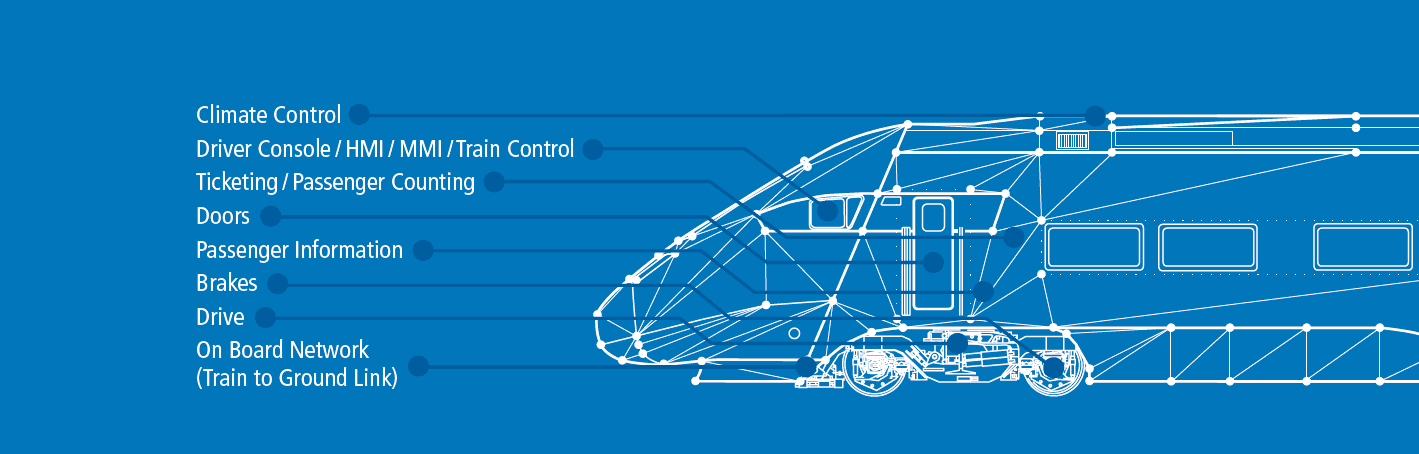
Since 1999, IEC 61375 has governed communication between the components of a train – originally via the fieldbuses Wire Train Bus (WTB) and Multifunction Vehicle Bus (MVB). As the number of networked components grew, however, these buses quickly reached their bandwidth limits (1.0 and 1.5 Mbit/s respectively).
Since 2012, the standard has therefore been progressively extended with Ethernet-based variants. The Ethernet Train Backbone (ETB) replaces the WTB as the train bus, while the Ethernet Consist Network (ECN) takes over the role of MVB and CAN at the vehicle level. With data rates of up to 1 Gbit/s (100 Mbit/s being standard), Ethernet provides the flexibility needed for modern on-board services. ETB also supports up to 63 nodes instead of the previous 32 – the nodes themselves handle automatic detection of the train topology (train inauguration). The switches in the ECN can be connected in a ring topology, so that all end devices remain reachable even if a cable fails.
New in the Standard: Cybersecurity as a Core Component
The revision IEC 61375-1:2026 introduces a significant content expansion: for the first time, requirements and guidelines for protecting communication networks against unauthorized access and cyberattacks are firmly anchored in the standard. This covers the entire product lifecycle – including the particularly critical interface between the train and the outside world. Specifically, the standard addresses, among other things:
Authentication and authorization of communication participants
Integrity protection of transmitted data
Confidentiality of communication
Requirements for secure gateways
With this, the standardization body is responding to a trend observed across many industries: functional safety alone is no longer sufficient – networked systems need information security (security) built in from the start as well. For train manufacturers, this means security requirements must be planned into the TCN architecture from the outset, rather than added retroactively.
In addition, the revision defines two alternatives for redundant backbone design, as well as options for wireless train backbone and consist networks.
Outlook: TSN
In the long term, the TCN is expected to be extended with real-time-capable Ethernet standards (Time Sensitive Networking, TSN) – among other things as part of the OCORA initiative of European railway operators such as Deutsche Bahn, SNCF, ÖBB, and SBB. In practice, however, TSN is not yet an urgent topic for most manufacturers.
Conclusion
With the migration to Ethernet and now the mandatory inclusion of cybersecurity requirements, IEC 61375 is consistently evolving toward modern, networked, and at the same time secure train communication. Vehicle and component manufacturers benefit from taking an early look at these new requirements – especially now that security aspects are just as firmly embedded in the standard as classic safety requirements.
As a long-standing expert in train communication networks, NewTec supports vehicle and component manufacturers in implementing IEC 61375 – from architecture design to standard-compliant protection in line with both safety and security requirements. Learn more about our work in the railway sector on our Railway solutions page.